

News
June 14, 2017Neoliberal governments are the culprit, not the Collapse
Inan articlein Fréttablaðið today, Sölvi Blöndal, Gamma's ideologist, claims that the deterioration of infrastructure in Iceland can be traced to the Collapse, that public debt then increased so much that it lacked the capacity for new investments, not even to maintain the infrastructure stock. This is wrong of Sölvi, as everyone knows.
Although many municipalities are quite indebted, the Icelandic state now owes less than for a long time. The reason for less infrastructure development in recent years is primarily the consequences of government policy of the last decades; to spend treasury funds on tax breaks for companies and the wealthier, and a generous surplus from treasury operations; instead of building up infrastructure or strengthening the welfare system. Iceland's problem is long-standing neoliberal economic management. The Collapse was certainly a consequence of it, but only a small part of the damage that neoliberalism has caused.
This can be read from the charts that Sölvi includes with the article. They show that the problem did not arise with the Collapse, but rather, they show that the neoliberal economic management had begun to significantly undermine the community's infrastructure around the turn of the last century.
[Image: image]
Let's recall the three stages of neoliberalism:
- Taxes on companies and the wealthier reduced. Public funds indebted to meet the revenue loss. The theory is that revenues will increase again later so that the entire society will ultimately profit greatly from tax cuts for the rich.
- The benefits of tax cuts are slow to materialize. Fees increased within the welfare system to meet the revenue loss, investments in infrastructure reduced, and state assets sold to plug the gap. Efficiency demands increased within the welfare system, staff laid off, and services cut. Housing benefits, child benefits, personal tax credits, and other income-equalizing elements of the tax system reduced, and taxes thus increased on general wage earners, especially those with the lowest wages and lower average wages.
- Still no news of increased revenues due to tax cuts for the wealthier. Even more state assets sold, fees within the welfare system further increased, and infrastructure fees imposed and then greatly increased. The welfare system cut even further. Parts of the community's basic systems transferred to private entities; for example, in the healthcare, education, and road systems, and public tax money thus privatized.
The result of this path is the complete breakdown of society, the transfer of all wealth to the very richest, the collapse of the middle class into the lower class, and the economic collapse and powerlessness of the lower classes. Sölvi writes his article when we are well into the third phase of neoliberalism's destruction of society and encourages us to continue on the same path. We are "On the Right Track," as the Independence Party (Sjálfstæðisflokkurinn) phrased it before the last elections.
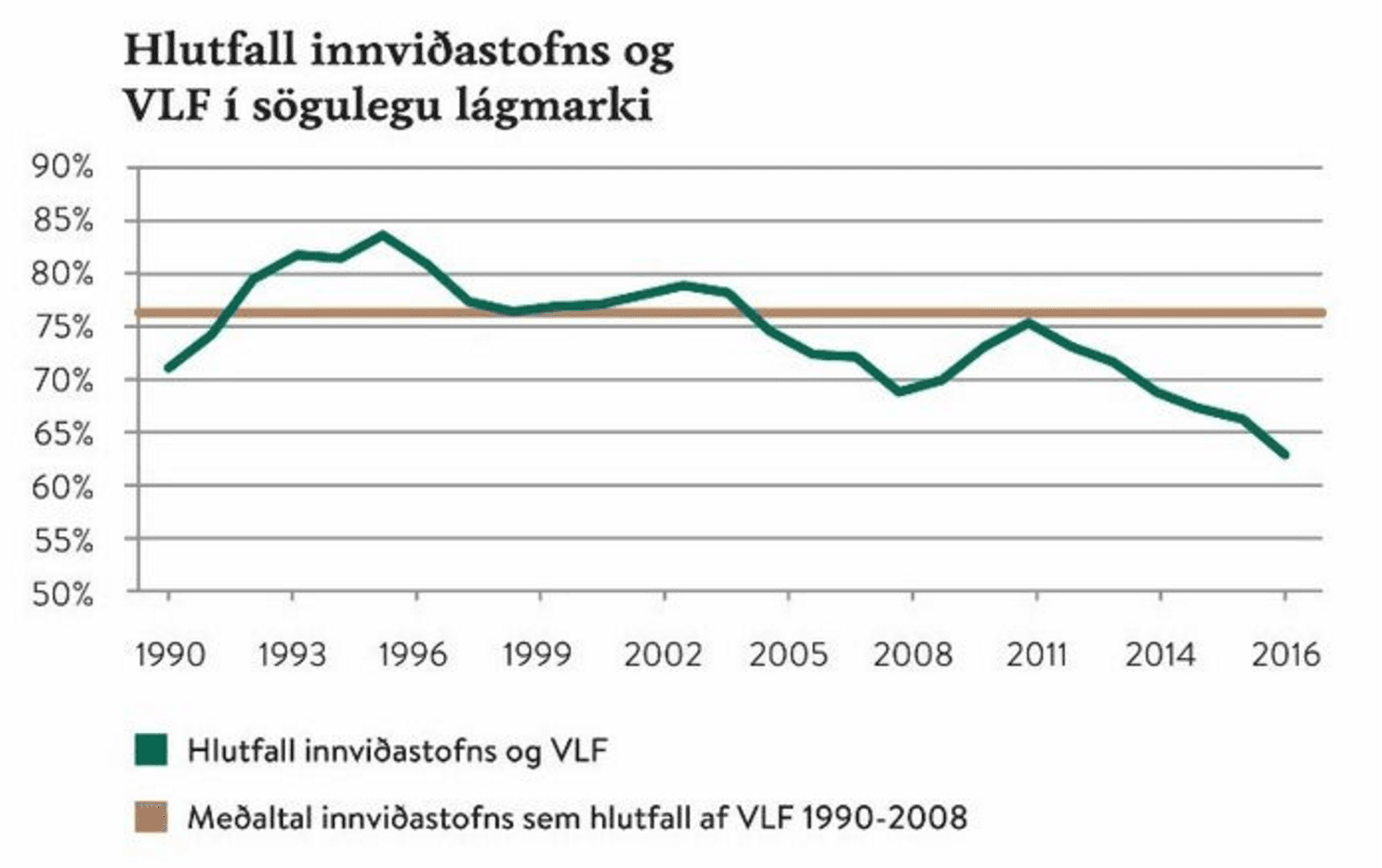
The first chart Sölvi presents shows the development of infrastructure stock (hospitals, schools, ports, airports, roads, bridges, tunnels, electricity transmission systems, broadband, and other IT infrastructure) as a percentage of GDP (the green line) compared to the average for the years 1990-2008 (the golden line). The green line shows that the infrastructure stock rapidly declined from the turn of the century and decreased until the Collapse, then rose (primarily due to decreasing GDP) but has since declined again from 2011, when the increase in tourists began to boost GDP.
But what story does the green line tell?
It shows a growing infrastructure stock as a percentage of GDP following the national reconciliation agreements before 1990, not least due to decreasing economic growth and GDP, but then a fairly steady and certain deterioration until the Collapse, especially after the tax reduction plans of the Independence Party came to fruition around the turn of the century; abolition of property taxes, corporate income taxes reduced to 15%, and capital gains tax to 10%. The deterioration of infrastructure goes perfectly hand in hand with the deterioration of the tax system. Taxation no longer serves the interests of society but only the richest.
The green line shows that the ratio increases during the government of Jóhanna Sigurðardóttir, mostly due to a fall in GDP but also due to some increase in corporate and capital taxes (fishing fees, energy tax, wealth tax, increase in capital gains tax and corporate income tax) but then falls again when GDP increases and the government of Sigmundur Davíð abolishes a large part of the tax increases of the left-wing government.
In reality, this green line shows a great tragedy. Icelanders went further down the path of neoliberalism than most other nations, partly because there were few defenses here (the successors of the socialist parties adopted neoliberal economic policies and the labor movement played along). Despite this policy leading to a greater collapse for Icelanders than other nations; that great collapse did not lead to any radical changes in the policy. It was more or less rebuilt along with all the companies and banks that had caused the Collapse. If there had not been an increased injection of capital due to a large increase in tourists, welfare services would have had to be cut even more drastically, in addition to the systematic deterioration of infrastructure.
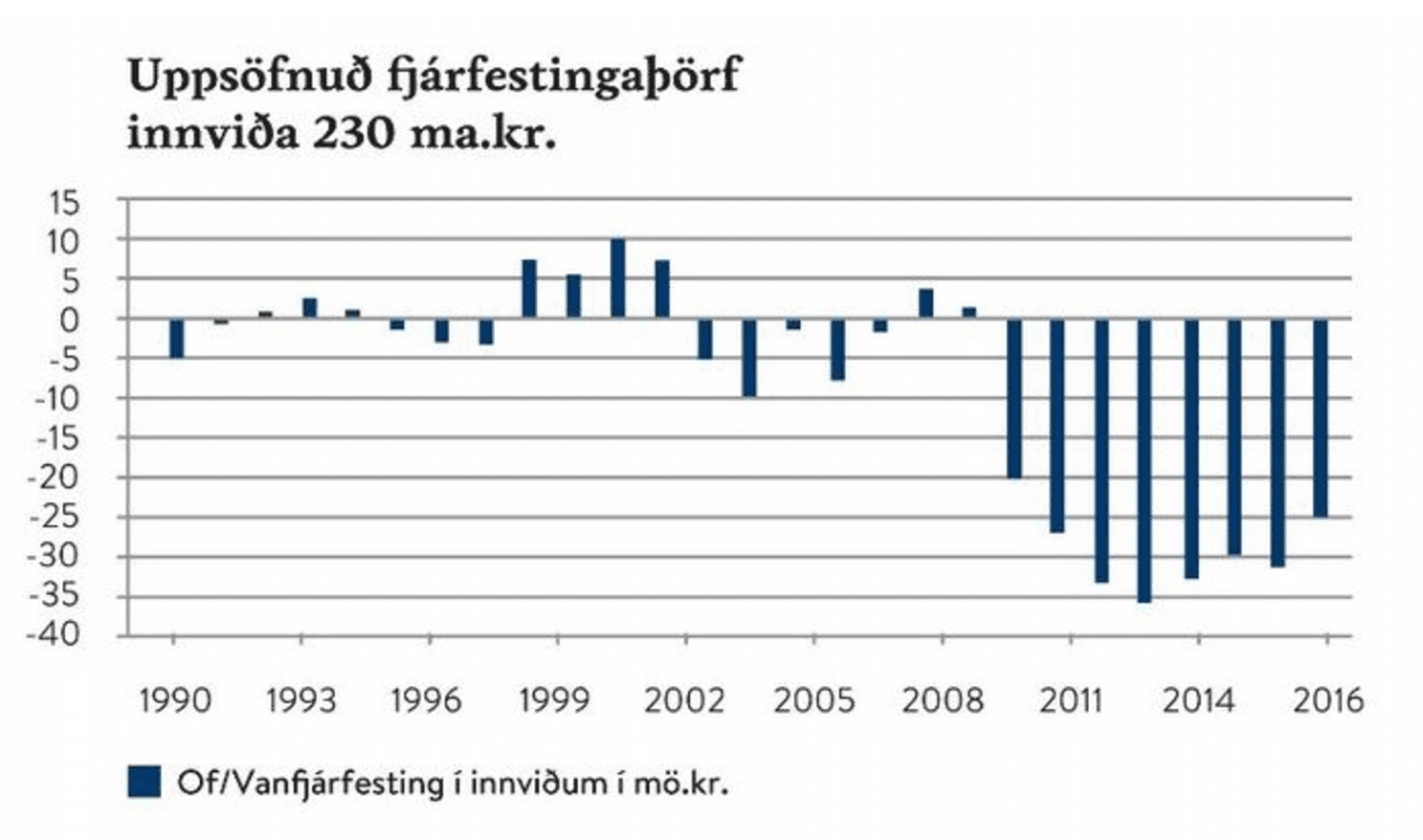
Sölvi's next chart tells the same story. Long before the Collapse, the community's infrastructure was being eroded despite an imagined prosperity. The deterioration of infrastructure is therefore not a consequence of increased public debt due to the Collapse, but rather the deterioration was government policy. They chose to transfer funds from infrastructure development to the richest in society by foregoing normal taxation. The largest state contributions of recent years are thus not visible in the budget but rather occur before taxes are imposed; an enormous concession to capital and business owners, a concession that is in all likelihood about 100 billion ISK annually when compared to normal taxation in our neighboring countries or the tax rates that were considered normal a few years ago.
When the government decided to give these funds to the richest people in Iceland, no one asked where they intended to find them. There was no demand that they demonstrate how these tax cuts would be financed. Their financing, however, is evident, among other things, in Sölvi's charts, in the systematic deterioration of infrastructure. Furthermore, their financing is manifested in increasingly higher fees within the welfare system, the breakdown of the social housing system, reduced public services, lower benefits, and increased taxes on wage earners.
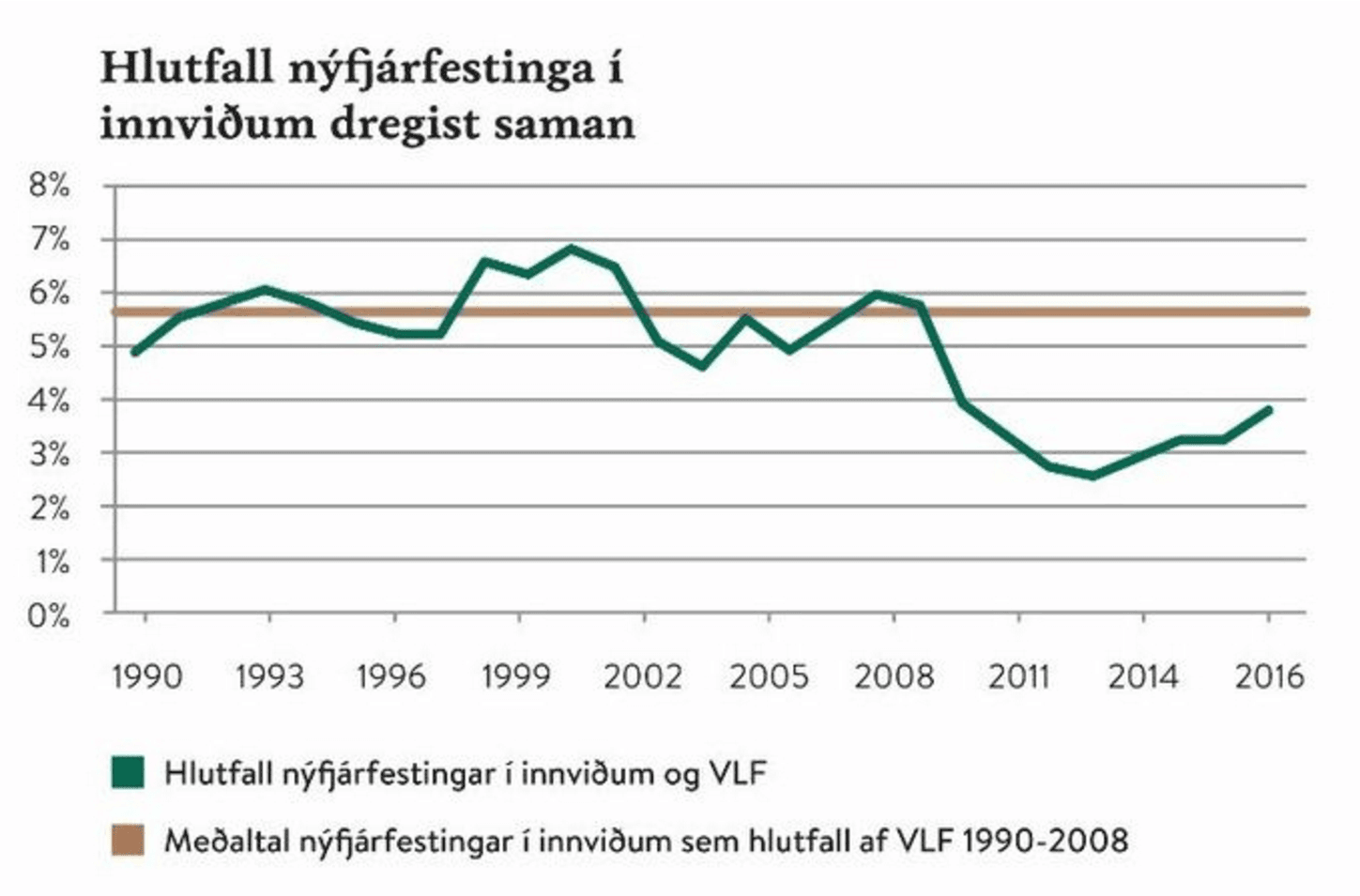
The last chart shows a similar story. The further the breakdown of the treasury's revenue generation system progresses, the less prepared society is to undertake new projects. A society that believed it could build the Kárahnjúkar Hydropower Plant around the turn of the century to provide electricity to a single workplace in Reyðarfjörður is completely unable to secure housing for young people, disabled individuals, and low-income earners. A society that manages to give the very richest tax breaks of 100 billion ISK annually cannot manage to build a new National Hospital.
Thus, neoliberalism has not only undermined the treasury's revenue generation but also crushed all courage and spirit in society; politics passively watches the distress of people due to the collapse of the housing market, after its development was fully transferred from the government to the so-called free market, where vulture funds like Gamma rule supreme and drain the life force from young people, pensioners, and low-wage earners. Politics stands helpless before the housing needs of the National Hospital despite the urging of almost all voters in the country for the reconstruction of the healthcare system. They have lost faith that it is their role to shape society. After the long reign of neoliberalism, politicians have become so brainwashed by its absurd theories; that they believe their role is not to shape society with social actions but rather to gently stroke the market so that it might perhaps provide the solutions.
Which it never provides. At least not solutions for the general public. The market's solutions are never other than those that best serve those who control the market, those who own the most money and thus wield the most power in the market, dominating it.
In this situation, the complete blindness of politics to the ongoing coup by the wealthy, the transfer of power from the social sphere (where every person has one vote) to the so-called market (where every króna has one vote), in the slow and certain repolarization of society from democracy to plutocracy; Sölvi Blöndal, economist of the year, appears with a new offer, which reads as follows (if I may rephrase it):
Now that common funds have been broken with tax breaks for the wealthy, so much so that the welfare system is dissolving and the community's infrastructure is deteriorating, I hereby recommend an offer to you from the rich. We are willing to let some of the money you gave us, through generous tax breaks, flow into infrastructure development, provided that roads, airports, schools, hospitals, and the like are transferred from common ownership and common administration to us, the rich. If our plan succeeds, your common assets will become ours, not unlike what has happened with the fish in the sea. We think that's a good system. It has made us even wealthier and more powerful. And you poorer and less powerful. Which is fine. Because then we can continue to crush the welfare system, which we don't need at all because we have enough money to pay for education, healthcare, and the like. We are not dependent on common welfare; we lose on it; we pay more than we receive. That's why we stopped paying taxes and want to use money to buy up what's left of your common assets and build new ones so we can charge you and thus transfer taxation from the state to us.
Something like this is the offer that can be called "On the Right Track."
And how do you want to answer that? Yes, please?
It is long past time to tell this utterly insane group to shut up, push them from power and begin to shape a society that serves more than just the very richest. This article by Sölvi must awaken people from their slumber, and he should be thanked for that. If the public does not soon rise up and seize power in society, there will be no society left. It will have become the private property of a few families.
Gunnar Smári